
Why Gutter Guards Overflow in Heavy Rain, and What Stops It

In a light rain, almost any gutter guard looks like it works. The water moves slowly, the guard catches it, and the gutter fills the way it should.
The trouble shows up in the storm that actually counts. Most guards, reverse curves and ordinary micromesh alike, try to catch water right at the front edge of the gutter. When rain gets heavy and the water is moving fast, it blows straight past that edge. No clog. No blockage. Just water pouring over the front.
HydroVortex™ is one of five guardians in Klean Gutter®'s AEGIS 5X® engineering standard, and it owns one thing: where the water gets caught. It moves the catch point back, over the inside of the gutter, before the water ever reaches the front lip, and it uses the water's own speed to pull it in. The harder it rains, the harder it grabs, the exact opposite of how a front-edge guard behaves.
Before you choose a guard, ask one question: where does the water actually enter the gutter, at the front edge, or over the trough? That answer tells you whether the guard was built for the drizzle or for the downpour.
Your Questions Answered
Do gutter guards work in heavy rain? Most don’t, and not because they’re clogged. Jump to full answer
Why is water pouring over my guards in a downpour Because the thing meant to pull it in, gravity and the way water clings to a surface, hit its limit and the water was moving too fast to redirect at the last inch before the edge. Jump to full answer
Why do guards fail in heavy rain when they’re fine in light rain? Because the gentle forces that guide slow water in run out when the water speeds up. Jump to full answer
Want to know if your roof is one that overflows? A MasterShield advisor will read your roof geometry and tell you whether your guard is built for the storms that actually arrive.
10M+ Linear Feet Installed | 0.009% Warranty Claim Rate | ASTM B117-16 Passed 1,000-Hour Corrosion Test | 5 Shingle Manufacturer Approvals | 3-Year Independent Real-World Field Test | 17 Utility Patents, All Insured by IPISC
The Front-Lip Problem: Why Most Gutter Guards Fail in the Storm That Tests Them
Here is what usually happens when a homeowner’s gutter guard fails in a hard rain: they climb up to check the guard after the storm, and the gutter is completely clear. No clog. No blockage. Nothing in the way.
The guard wasn’t clogged. The guard failed for a different reason entirely.
Most gutter guard systems are designed so that water enters the gutter at or near the front lip. That front lip is where their water-capture story ends. In most cases, it’s also where it begins. By the time water gets there, the system has already worked against itself in at least three ways.
First, shingles overhang the guard. Some fraction of the surface you thought you had is already covered before rain starts. The guard’s effective capture area is smaller than it looks.
Second, a flat guard with punch holes hasn’t solved the trough problem. It has moved the bottom of the trough up to the guard surface and replaced open space with a perforated one. In heavy rain, the question is whether water arriving at volume can be absorbed through those holes in the moment of contact. It cannot. The holes were not designed for that kind of throughput under that kind of pressure.
Third, many micro mesh guards use a filter pattern that runs from the back of the gutter toward the front. This design choice adds structural strength to the guard, but it routes all the water tracking across the top surface directly toward the front lip. The filter is working against the guard. Every drop that lands and follows those channels is being guided to the one place the system is least equipped to handle it.
So when the rain gets heavy and water arrives fast, it finds a front lip that is already doing the only job the system knows how to do: wait for gravity. Gravity is passive. It does not scale with volume and speed. The water that should have been captured somewhere along the filter surface ends up at the edge, and over it.
The gutter wasn’t the problem. The guard wasn’t clogged. What failed was the assumption that passive physics would redirect fast-moving water at the last possible point before the edge.
The diagnosis most homeowners get is wrong. “Clean your guard more often” doesn’t fix a capture-location problem. “Get a better filter material” doesn’t fix it either. The problem is not what’s in the way. It’s where the guard tries to catch the water, and what it does nothing about in the space between the shingle edge and the front lip. That is a design limitation, not a maintenance issue.

What HydroVortex Is, in Plain Terms
Before the engineering, here’s what it means for you: HydroVortex catches the rain over the inside of the gutter instead of at the front edge, and it uses the storm’s own speed to do it, so the heaviest rain is exactly when it works best. It’s one of the five guardians inside Klean Gutter’s AEGIS 5X® standard, and it’s the one in charge of how water gets into the gutter. It’s not something you buy on its own; it’s the intake mechanism built into every Klean Gutter. Here’s what it does, step by step.
Step 1: The water keeps its speed
Most guards lie flat, below the shingles. Water drops off the shingle edge, falls through the air, and lands on the guard as a falling drop, and the moment it falls, it loses its forward push. From there, only gravity can move it through the filter. Klean Gutter is installed at the pitch of your roof, so the water slides straight from shingle to guard without ever dropping, and keeps all its speed. That speed is the engine for everything that follows.
Step 2: The openings face the water
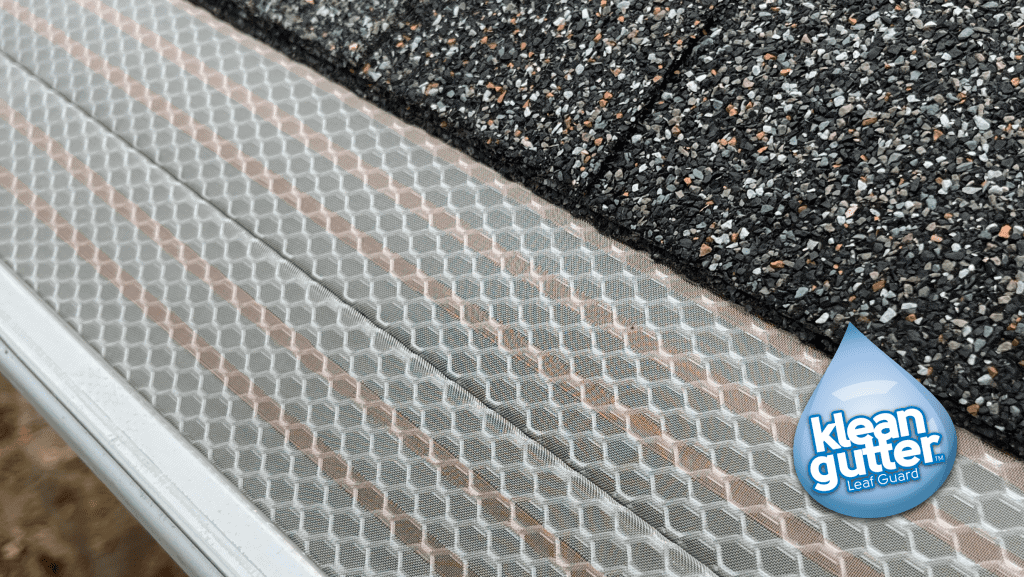
The filter openings sit on the upward-facing side of small ridges that run along the roofline, so they face right into the oncoming water instead of lying flat. Think of a storm grate on a steep street, angled to scoop fast water down instead of letting it skip past. The water’s own momentum drives it into the opening, and faster water means a more forceful catch. That’s why a downpour makes this system work better, while a flat mesh gets overwhelmed.
Step 3: The water lands over the trough, not the front edge
Once the water is through the filter and running along the underside, a ramp pressed into the metal, sitting right over the inside of the gutter, breaks it loose and sends it straight down into the trough. Not at the front edge. Not over the side. Right where it belongs. So the harder it rains, the more forcefully the water is caught and the further it lands from the edge. A front-edge guard does the opposite: the harder it rains, the more water it loses.
"Every passive guard makes the same bet, that gentle physics will turn fast water at the last inch before the edge. In a real storm, it doesn't. I designed HydroVortex so the front edge is a last resort, not the plan. The water is already caught, over the trough, before it ever gets there.
— Karen Sager
How the catch actually works.
There’s a bonus to Step 2 worth knowing. When the water makes its sharp turn from running across the surface to dropping through an opening, that turn creates a tight little spin right at each opening, the same kind of swirl you see at a draining sink, and it has real force. That spin scrubs the inside of each opening, knocking loose any fine grit that tried to settle. The faster the water, the harder the spin scrubs. So heavy rain doesn’t just get caught better, it cleans the openings while it’s at it. And you can actually watch the catch happen: while water sheets across the top of the mesh, the surface looks glossy, like a wet windshield; the instant it drops through the openings and runs underneath, the surface goes matte and the shine breaks up. That glossy-to-matte shift is the moment of capture, made visible, and no flat guard shows it.
Where HydroVortex Shines, and Where Any Guard Needs Help
There are four roof conditions where passive gutter guard systems fail most completely and most visibly. In three of them, HydroVortex performs best because of those conditions. The fourth requires an honest answer.
Steep roofs: the surprise
If you have a steep roof and you’ve talked to other guard companies, you’ve probably heard it called a “complication” they have to work around. For a passive guard, that’s fair. For a momentum guard, it’s backwards. On a steep roof, gravity pulls the water faster, so it arrives at the filter with more speed. For a flat mesh, that’s bad, fast water skips over the surface instead of going through. For HydroVortex, faster water means a more forceful catch, and the openings line up better with the water’s angle too. Within the normal range of residential roofs, steeper is genuinely better here. So here’s a quick test of who you’re talking to: if a company says your steep roof is a problem to work around, they have a passive guard. If they say it’s an advantage, they have a momentum guard.
What happens on a flat or low-slope roof
Most of the HydroVortex story is about fast water, the momentum a steep roof builds before it reaches the gutter. Flat and low-slope roofs are the opposite problem, and they expose passive guards just as badly.
Picture the Mississippi River. Up in Minnesota it runs fast and nearly straight, a direct shot south. By the time it reaches Louisiana it has slowed down and started to wander, folding into big S-curves and oxbows. Water on a flat roof does the same thing. A pitched roof that drains onto a flat or low-slope section loses most of its speed at the transition, and from there it stops moving in an even sheet and starts finding winding channels instead. Any debris or small change in the roof surface nudges those channels somewhere new, so the water reaches the gutter in narrow, shifting streams. The two problems on a flat roof are slow water and uneven, channelized shedding, and a small obstruction changes the water’s path far more than it would on a roof with real pitch.
That behavior is where passive systems fail. Reverse-curve guards need water to sheet across a surface and cling to a curve to work at all, and on a flat roof that sheeting never forms, which is why most reverse-curve systems aren’t even installed on flat roofs and overshoot badly when they are. Flat screens and punched-hole guards have no way to draw a slow, wandering stream in: in heavy rain there’s nothing to force the water down into the guard, so the stream runs all the way to the front lip and over it. Punched-hole guards add a second problem, they collect debris instead of shedding it, and over time that buildup not only disrupts what little flow a flat roof delivers but lets debris work its way down into the gutter itself.
HydroVortex is built for exactly this. It isn’t tall enough to trap debris, and it doesn’t try to; instead it works as a series of break points across the guard, each one acting like a small dam that forces a passing stream down into the trough interior rather than letting it run to the front edge. Because there are multiple break points along the guard, a flat roof’s wandering, uneven streams get caught wherever they happen to arrive, and the debris keeps shedding off the top instead of stacking up at the catch. Where a low-slope roof doesn’t provide enough natural angle, PitchPerfect™, the AEGIS 5X alignment standard, can add the pitch the guard needs so water keeps moving toward those break points instead of pooling.
Valleys: the straight answer
A valley dumps the runoff from two roof faces into one stretch of gutter, which is the highest volume and speed on most roofs. Straight answer: if that gutter is undersized or set wrong for the water arriving from two planes, it will overflow no matter whose guard is on it. Klean Gutter is no exception. A guard can’t fix a gutter that’s the wrong size for its drainage. So the real question at a valley isn’t “which guard,” it’s “is my gutter sized and placed right for the volume?” When it is, HydroVortex handles valley conditions well, because high speed and steady volume are exactly what it runs on. But the gutter has to be right first, and your installer should confirm that.
Long runs: steady high volume
A big roof face that drains into one stretch of gutter delivers more water, for longer, than a standard estimate expects. A passive guard starts overflowing early in the storm and keeps it up. HydroVortex takes that same extra volume and uses the momentum that comes with it, the same mechanism, just handling more water as the storm builds. Your installer should still confirm the setup for your specific roof.
Notice the pattern: the very things that overwhelm a passive guard, speed, volume, and concentrated runoff, are the things HydroVortex runs on. The one real exception isn’t the guard at all. It’s a gutter that was the wrong size before anyone put a guard on it.

Steep roof, valleys, or a long run feeding one corner? Those are the conditions that beat a front-edge guard, and the ones HydroVortex is built for. A Klean Gutter advisor will read your roof and tell you where the water is actually going.
10M+ Linear Feet Installed | 0.009% Warranty Claim Rate | ASTM B117-16 Passed 1,000-Hour Corrosion Test | 5 Shingle Manufacturer Approvals | 3-Year Independent Real-World Field Test | 17 Utility Patents, All Insured by IPISC
What It Actually Costs When Gutters Overflow
Water that misses the gutter doesn’t vanish. It lands somewhere, and where it lands, it does damage, not all at once, but in the same spot, every storm, for years. That adds up.
The foundation
The most expensive one. When water lands over and over right below the gutter edge, it soaks the soil against your foundation. That wet soil doesn’t drain fast, it holds water against the wall under pressure, and that pressure slowly forces moisture through any gap it can find. The homeowner notices a damp basement and blames “humidity,” never connecting it to what’s happening five feet up at the gutter during every storm. Those expensive drainage jobs that get traced back to overflow didn’t start with one big failure, they started with a guard that couldn’t take a hard rain, and years of water hitting the same patch of ground.
Slab homes
A house on a concrete slab has its own version. Overflow soaks the soil at the slab’s edge, and over time water works under the slab and washes out the packed soil that supports it, leaving voids. The slab doesn’t move, but what holds it up does, and the first signs are cracks, settling, and uneven floors, usually the last thing a homeowner ties back to the gutter overhead. Fixing it means injecting fill under the slab and correcting the drainage. Not cheap, and not mysterious, just water landing in the same place every storm.
The fascia and the yard
The fascia boards behind your gutter get soaked only during overflow, which means they’re wet at exactly the worst times and dry in between, and that wet-dry cycling rots wood faster than steady moisture, often from the inside while the face still looks fine. Out in the yard, water falling from gutter height at storm volume hits hard, eroding mulch and soil and battering the plants at the drip line. That little trench under your gutter is one of the clearest signs the system is losing in heavy rain.
How often this actually happens
This isn’t hypothetical. Changing weather patterns are leaving more people with higher volumes of rain water over shorter times. You need a system that may not handle every freak microburst, but handles most of them. A guard that can’t is failing five to ten times a year, every year. And sometimes the guard isn’t the problem at all: we’ve seen homeowners told their guard “failed” and that they need a whole new system, when the real issue was too few downspouts to carry the water away. Two extra downspouts solved it. Someone will always try to sell you something you don’t need because they don’t understand what you already have on your house.

How to Judge a Guard for Heavy Rain
If heavy rain matters to you, you need different questions than most companies want to be asked. The GPH (gallons per hour) numbers and debris tests they quote are measured in calm lab conditions that look nothing like a five-minute summer downpour. A guard rated for plenty of gallons in the lab can still lose the first real thunderstorm.
Three questions to ask
- Where does water enter my gutter, at the front edge, or over the inside of the trough? This is the whole ballgame. Front-edge catch is passive by definition. Catching water over the trough takes real engineering. If the company hedges, or answers with “our filter is finer” instead of telling you where the water enters, the answer is the front edge.
- What happens when the rain doubles, and can you show me? Gentle physics has a ceiling. A momentum guard scales up with the storm. Ask to see it in real rain, or to look at an existing install during a downpour. A company that can’t answer, or won’t show you, hasn’t tested the thing that matters.
- How does it shed debris, and can you actually see that the guard is pitched? Taking water in is only half the job. A guard can pull water through and still let debris sit on top of it, and a flat guard does exactly that: with no slope, debris settles and stays. Pitch is what sheds debris, so look at the guard on the roof and ask whether you can actually see it following the roofline. If it sits flat over the gutter, water intake is the only problem it’s solving, and debris becomes your new maintenance headache. A flat guard taking in water and a pitched guard taking in water are not the same product over the years.
The field test you can do yourself
During any decent rain, watch the surface of a guard. Glossy and mirror-like means the water is still riding across the top, not caught yet. Matte and dull means the water has dropped through the openings and is running underneath toward the gutter. That glossy-to-matte flip is the catch, made visible, and a flat guard never shows it, because it never moves water that way.

Shortcuts that don’t actually test anything
When you’re trying to figure out if a guard will work on your house, three shortcuts will lead you into a bad decision.
- Trusting the GPH rating. It’s a lab test: they pour water steadily over a guard and measure how much goes through. It tells you nothing about a five-minute thunderstorm dumping a wall of water on your roof. A guard can ace a GPH test and fail the first real storm.
- “It works for my neighbor.” Your neighbor’s house isn’t your house. A flat roof with no valleys puts almost no stress on a guard; a steep roof with two valleys dumping into one corner is a hydraulic nightmare. What’s flawless on their roof might fail on yours.
- Trusting a brand from a dry state. A company that built its reputation where it rains 15 inches a year hasn’t engineered for the Gulf Coast. If they haven’t lived in the storms you get, they didn’t build a guard for them.
Find out, before the storm, whether your guard is built for it or just for the dry days in between. A Klean Gutter advisor will read your roof geometry, find the high-volume zones like steep sections and long runs, and match HydroVortex to your actual drainage, the right setup for your roof, not a standard package.
10M+ Linear Feet Installed | 0.009% Warranty Claim Rate | ASTM B117-16 Passed 1,000-Hour Corrosion Test | 5 Shingle Manufacturer Approvals | 3-Year Independent Real-World Field Test | 17 Utility Patents, All Insured by IPISC
Why Klean Gutter Builds HydroVortex Into AEGIS 5X
Every guardian inside AEGIS 5X exists for the same reason: your last line of defense should never be your only one. HydroVortex is the reason the front edge of a Klean Gutter is a backup instead of the main event. The water is caught over the inside of the gutter, not at the edge, so the storm that beats a passive guard is the storm this one is built for. That’s not a better version of front-edge catching, it’s a different approach to the whole problem, and it’s patented, the momentum-driven intake is an invention Karen Sager holds the patent on, so it’s a documented mechanical design, not a sales line.
But intake is only one of five jobs, and the reason Klean Gutter holds up over time is that the other four cover the rest:
| Guardian | What it handles |
|---|---|
| PitchPerfect™ | Keeps the guard on your roof's pitch, the angle that gives the water its speed |
| HydroVortex™ | Catches the water over the trough during heavy rain, not at the front edge |
| SelfClean Mesh™ | Keeps the openings clear, debris swept off by moving water, openings scrubbed by the spin |
| CopperCare™ | Holds back moss and algae, with copper woven right into the mesh |
| ShingleSafe™ | Protects the roof edge during install, so the guard meets the shingle without making a new weak spot |
PitchPerfect and HydroVortex are a matched pair: PitchPerfect keeps the guard on the roof’s angle, which is what gives the water its speed, and HydroVortex turns that speed into the force that catches the rain. And CopperCare is Klean Gutter’s standout, copper built into the micromesh that fends off the moss and algae most guards have no answer for. Five guardians, one job each. HydroVortex wins the storm; the other four make sure nothing else undoes the win, and the whole thing is backed by a 25-year transferable warranty.

The One Question to Ask Before You Buy
Before you choose any gutter guard, ask the company one thing: where does the water actually enter my gutter, at the front edge, or over the inside of the trough? If it’s the front edge, you have your answer, that guard was built for the easy rain, and the hard rain will find the edge. If it’s over the trough, the guard was engineered to use the storm’s own speed, and heavy rain is when it does its best work. That’s what HydroVortex does. The harder it rains, the harder it grabs. The only question that matters is whether your guard was built to win the storm or just survive the drizzle.

Every storm that beats a passive guard sends water to the same places, your foundation, your fascia, your drip line. Find out whether your roof is set up for the storms that actually arrive. A Klean Gutter advisor will read your roof geometry, your drainage zones, and your regional rainfall, and recommend the right HydroVortex configuration for your home, before you buy, not after.
10M+ Linear Feet Installed | 0.009% Warranty Claim Rate | ASTM B117-16 Passed 1,000-Hour Corrosion Test | 5 Shingle Manufacturer Approvals | 3-Year Independent Real-World Field Test | 17 Utility Patents, All Insured by IPISC
Frequently Asked Questions
Heavy rain and why guards overflow
Do gutter guards work in heavy rain?
Most don’t, and not because they’re broken or dirty. Most off-the-shelf guards catch water at the front edge and rely on gravity and surface tension to pull it in. Those gentle forces work in light to moderate rain. Once the rain is heavy enough that the water is moving faster than they can redirect, it overshoots the front edge and pours off the side. The issue isn’t the filter, it’s where the guard tries to catch the water. HydroVortex catches it over the inside of the gutter using the water’s own speed, so the faster the rain, the more forcefully it enters. Heavy rain improves it instead of overwhelming it.
Why is water pouring over my guards in a downpour?
Because the forces meant to pull the water in, gravity and the way it clings to a surface, ran out of capacity, and the water’s speed carried it past the edge. This gets misread as a clog almost every time. Easy test: check the gutter after the next overflow. If it’s clear and the guard isn’t blocked, the failure wasn’t a clog, it was a catch-point problem. Water moving faster than gentle physics can turn will always overshoot a front-edge guard, which is the failure HydroVortex, the AEGIS 5X intake guardian, is built to replace.
Why do guards fail in heavy rain when they're fine in light rain?
Because the forces that guide water in during a light rain have a limit. Light rain moves slowly enough for them to work; heavy rain moves too fast, so the water reaches the edge with enough speed to carry past it. The forces are the same in both, the rain is what changes. A guard built only for light rain has no backup for the heavy stuff, which is why HydroVortex, the AEGIS 5X intake guardian, uses the heavy rain as its fuel instead.
How HydroVortex works
What is HydroVortex?
HydroVortex is the intake mechanism inside Klean Gutter, one of five guardians in AEGIS 5X, and it governs how water gets into the gutter. You can’t buy it on its own. What makes it different is that it uses the water’s own speed to drive it through upward-facing openings and deliver it over the inside of the gutter, instead of waiting at the front edge for gravity to pull slow water in. The front edge is a backup, not the plan.
How is it different from a regular micromesh guard?
A regular micromesh is installed flat, below the shingle line. Water drops off the shingle onto it as a falling drop with no forward push, and from there only gravity can move it through. In heavy rain the volume beats gravity and the water skips across and waterfalls off the front. HydroVortex is pitched with the roof, so water arrives with its full speed, and the upward-facing openings use that speed: the faster it comes, the more forcefully it’s caught. Heavy rain helps it instead of beating it.
What does "momentum-driven" actually mean?
It means the filter uses the water’s own speed to push it through, instead of waiting for gravity to pull slow water down through flat holes. When the water is moving fast, like it does in a storm, that speed becomes the force that drives the catch. So HydroVortex, the AEGIS 5X intake guardian, doesn’t get overwhelmed by heavy rain, it works better in it, because heavy rain is exactly what creates the energy it runs on.
Steep roofs and valleys
Does Klean Gutter work on steep roofs?
Yes, and steep pitch is an advantage here, not a complication. A steeper roof speeds the water up, and because HydroVortex runs on the water’s speed, faster water means a more forceful catch through the upward-facing openings. The openings also line up better with the water’s angle on a steep roof. Within the normal range of residential roofs, steeper is better for this system, the opposite of how a passive guard behaves.
Will a valley overflow no matter what?
A valley concentrates the runoff from two roof faces into one stretch of gutter, the highest volume on most roofs. The straight answer: if that gutter is undersized or placed wrong for the volume, it’ll overflow regardless of the guard, and Klean Gutter is no exception, because no guard can fix a gutter that’s the wrong size. When the gutter is sized right, HydroVortex handles valley conditions well, since steady high volume is what it runs on. So the question at a valley is whether the gutter is right first, and your installer should confirm it.
What overflow costs
Can overflowing gutters really damage my foundation?
Yes, and it’s one of the most common ways foundation trouble starts without the homeowner knowing. When water lands at the foundation over and over during storms, it soaks the soil and presses moisture against the wall under pressure, which forces it through gaps and joints over time. A damp basement or crawl space that gets worse with storms, rather than with general humidity, often traces straight back to gutter overflow at the foundation line, which is the overflow HydroVortex, the AEGIS 5X intake guardian, is built to prevent.
How often do these heavy storms actually happen?
More than most people think. NOAA Atlas 14, a free National Weather Service tool, lets you look up your zip code and see how often a 2-inch-per-hour storm is expected where you live. It’s observed data, not a worst-case guess. For most of the country those storms come several times a year, and for the Southeast and Gulf Coast they’re routine, which means a guard that can’t handle them is overflowing five to ten times a year, exactly the storm load HydroVortex, the AEGIS 5X intake guardian, is built to win.
How do I know if my guard works in heavy rain?
The simplest check is to watch the surface during a moderate-to-heavy rain. On a HydroVortex install within AEGIS 5X, the mesh shifts from glossy to matte as the water drops from the top surface to underneath, the visible sign the catch is happening over the trough. A passive guard shows no such sign, because the water never moves through that sequence. And the after-the-storm test still holds: if the gutter is clear after an overflow, it wasn’t a clog, it was a catch-point failure.
Do GPH ratings matter?
GPH (gallons per hour) measures how much water a guard moves under calm, steady lab conditions. What it doesn’t measure is whether the catch holds up during the five-minute peak of a real storm, which is the part that actually fails. A big GPH number isn’t a promise of storm performance. Ask the better questions instead: where does the water enter, what happens when the rain doubles, and how does it shed debris while staying visibly pitched? HydroVortex, the AEGIS 5X intake guardian, answers all three by catching over the trough on the storm’s own speed.

Karen Sager — Author.
Karen Sager is the President of MGP Manufacturing LLC and a veteran of more than 20 years in the gutter protection industry. She holds nine utility patents for gutter guard filters and components, and she's the inventor of both the CopperCare copper-in-the-mesh weave and the HydroVortex momentum-driven intake. She works closely with the national dealer network on real-world installs, and what she writes about gutter guards comes from engineering she designed and tested, not marketing claims.

Contributor — Aaron Kapfer, Field Authority.
Aaron is the Success Team Leader at MGP Manufacturing LLC and has worked in gutter protection since 2000. He has spent more than two decades across the industry, training installers to read real roof conditions and set realistic expectations with homeowners. He contributes field perspective to this page; the page's author is Karen Sager.
