
Gutter Guard Pitch: Why a Flat Guard Becomes a Shelf

Your roof already does the work of shedding debris. Every inch of it is tilted so rain, wind, and gravity carry leaves and grit down and off the edge, on every storm, for as long as the roof stands.
A gutter guard can quietly shut that off. Screens, foam, brushes, reverse curves, and most micromesh all lay flat where the roof’s slope ends, and a flat spot at the roof’s edge is a place for debris to stop and sit.
PitchPerfect™ is one of five guardians in Klean Gutter®’s AEGIS 5X™ engineering standard, and it owns the angle. It sets the guard to your roof’s actual pitch instead of flat over the gutter, so the same slope that sheds leaves keeps shedding needles and grit too. The roof keeps moving debris; the guard doesn’t get in the way.
This isn’t a small tweak over a flat guard. It’s the difference between a guard that continues your roof and one that interrupts it at the most important inch.
Before you choose any guard, ask one thing: does its surface follow your roof’s pitch, or flatten to the gutter? That answer tells you whether you’re buying a guard that works with your roof or one that fights it.
Start Here: The Quick Answers
Does a gutter guard need to be pitched like the roof? Yes. A gutter guard needs to follow your roofline so the wind, gravity, and runoff already moving debris down the roof keep working right at the edge. Wind can only clear debris it can reach, and a flat guard hides debris from it. PitchPerfect keeps the guard on your roof’s angle so those forces don’t quit at the gutter.
What happens if a guard is installed flat? A guard installed flat becomes a shelf. Leaves, pine needles, grit, wet spring debris, and winter melt land on that shelf and stay, which means buildup on top, overflow in heavy rain, and ice at the edge come winter. PitchPerfect removes the shelf by continuing your roof’s slope instead of flattening over the gutter.
Can a gutter guard cause ice dams? Gutter guards can add to ice-dam risk when they’re laid flat. A flat guard makes a spot at the roof’s edge where meltwater and ice stop and sit, and that frozen mass can block the next melt. Ice dams have several causes, attic heat, roof temperature, snow load, freeze-thaw, but a flat guard adds one more place for water to stall. A pitched guard gives that water somewhere to go.
Not sure whether your guard follows your roof or flattens over the gutter? A Klean Gutter advisor will read your roof pitch, your valleys, your steep sections, and your shingle line, and tell you straight whether the guard is riding the roof or sitting on a shelf.
10M+ Linear Feet Installed | 0.009% Warranty Claim Rate | ASTM B117-16 Passed 1,000-Hour Corrosion Test | 5 Shingle Manufacturer Approvals | 3-Year Independent Real-World Field Test | 17 Utility Patents, All Insured by IPISC
Why Pitch Matters More Than Most Homeowners Realize
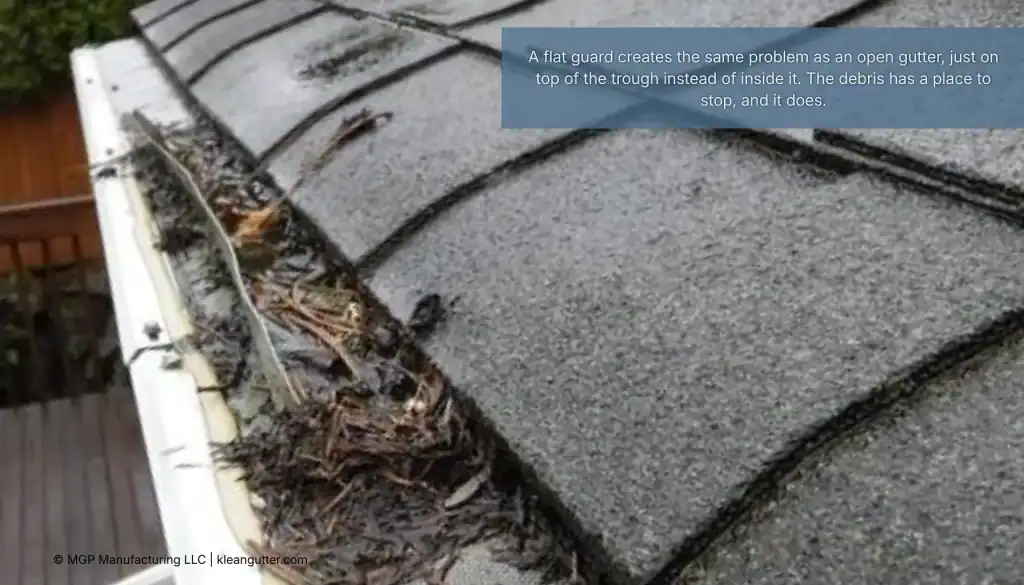
Walk out after a normal week of weather, a little wind, a little rain, maybe a frost, and look up. There’s a mat of leaves and needles sitting on top of your guard. The trough underneath is clear, so the guard is “working,” right? But that debris is parked on the surface, packing down, starting to look like it belongs there. That’s not a small annoyance. That’s the guard making a shelf at the edge of your roof.
Here’s the part the marketing skips: this isn’t a flaw in one kind of guard. It’s not a screen problem or a foam problem or a micromesh problem. It’s been true of every guard category since the first screen got laid flat over a gutter. New material, same promise, same shelf.
Most guards are designed starting at the gutter, clip to the fascia board (the board behind the gutter), cover the opening, keep big debris out of the trough. The roof’s angle gets treated as a detail instead of the whole point. And that’s the trap: a surface that doesn’t continue your roof’s slope doesn’t inherit your roof’s ability to shed. It just sits there, and whatever lands on it gets a place to rest.
Your gutter is already a flat shelf, a guard can just move it
Think about your open gutter right now. The bottom of that trough is a flat surface at the roof’s edge, debris drops in, grit settles, sediment builds, and that’s exactly why gutters clog. Put a flat guard on, and you haven’t solved that. You’ve moved it. You took the flat bottom of the gutter and set a new one on top.
A flat guard can keep junk out of the trough while still building a shelf above it. The trouble starts the moment leaves, needles, grit, or wet debris stop moving long enough to pile up. The angle is what sheds; the shelf is what collects.
Keeping debris out of the gutter isn’t the same as keeping it moving
There’s a real difference between blocking debris from the trough and keeping debris from stacking up at the roof’s edge. A guard can ace the first and flunk the second. When wet, packed debris builds on top, it can block water from even reaching the opening, so the guard is technically doing its job while your gutters overflow.
You already know what that looks like: black streaks down the fascia, water marks on the soffit (the panel under the roof overhang), wet wood behind the gutter that never dries, overflow at the downspout in an ordinary rain. The guard passed the trough test and failed the roof-edge test. The roof-edge test is the one that matters.
This is true of every kind of guard
Pitch isn’t a feature one brand owns. It’s a standard at the roof’s edge that every guard either meets or doesn’t. Most guards are built around covering the gutter. PitchPerfect is built around continuing the roof. That one difference, covering versus continuing, is where the shelf problem begins. It’s the first question the AEGIS 5X standard asks before anything else: does this guard keep the roof’s shedding going, or start a new place for debris to stop?
What PitchPerfect Is, in Plain Terms
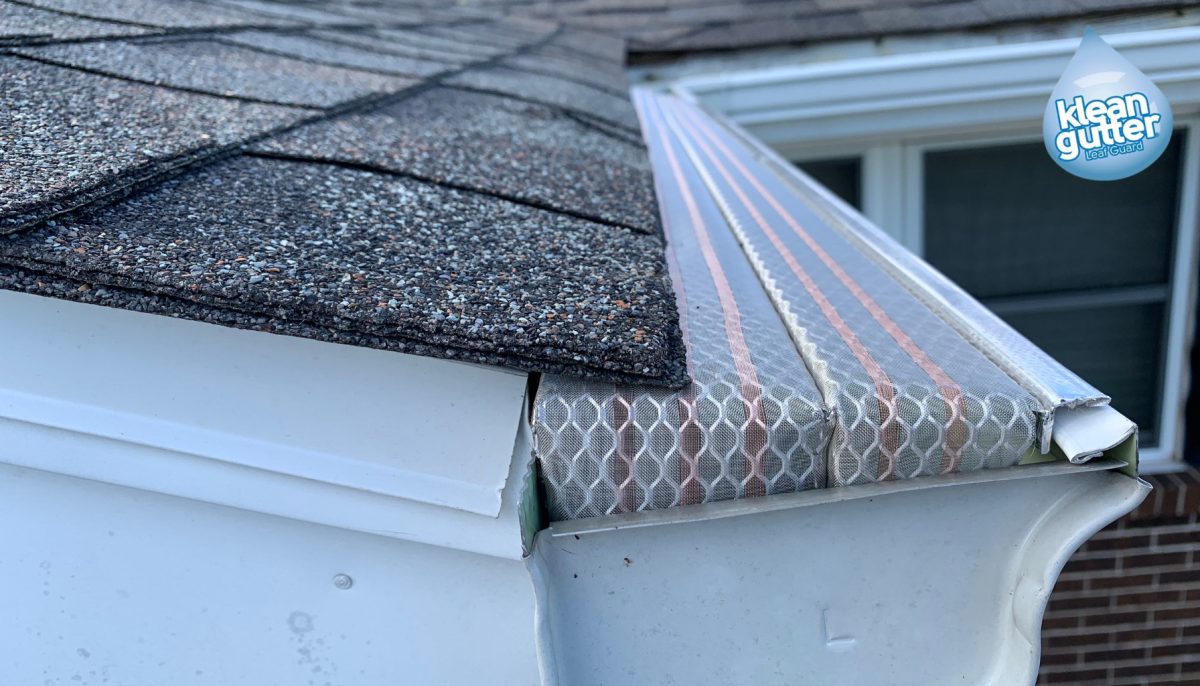
Before the engineering, here’s what it means for you: PitchPerfect makes sure your guard rides the angle of your roof, so the roof’s natural shedding keeps working instead of dead-ending at a flat shelf.
Picture water blasting off the front of a gutter in a downpour. The homeowner below figures the gutter’s clogged. Someone climbs up, and it’s bone dry, the water never got in. The guard redirected it over the edge before it reached the opening. That’s not a clog. That’s a pitch problem, a surface that fought the water’s momentum instead of carrying it along.
PitchPerfect is the angle answer. It’s not “set the guard at some tilt.” It’s the roofline-alignment standard inside AEGIS 5X: the guard should continue your roof’s natural shedding instead of breaking it with a flat shelf.
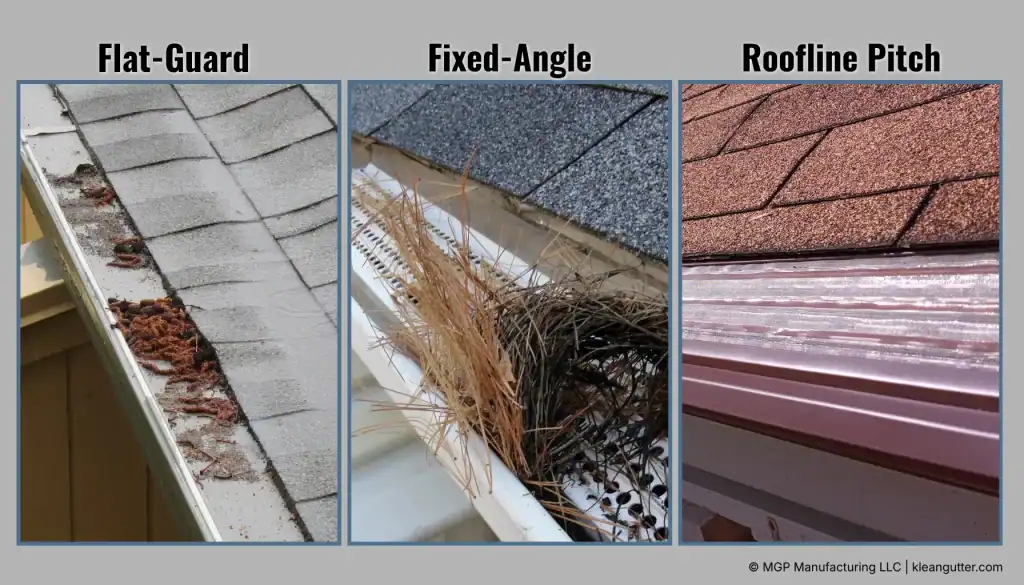
Most guards that claim “some pitch” use a slight fixed angle, a set number of degrees that sounds better than flat but isn’t calibrated to your actual roof. It’s better than flat and still short. A guard tilted a few degrees isn’t the same as a guard that closely follows your roofline so wind, gravity, and runoff all work together. A slight fixed angle just tilts the shelf. The debris still finds a place to stop. The ice still finds a place to sit. The wind still passes over instead of through.
Pitch lets three forces work together
Gravity does its job on a slope. Debris has a reason to slide instead of sit. On a flat surface, gravity pushes straight down into the debris, so it lands and stays until something else moves it.
Runoff travels across an angled surface instead of pooling. On a flat guard, water slows, spreads, and finds the edges, which aren’t always the gutter opening. On a pitched surface, the water follows the angle straight toward the intake.
Wind clears debris best when it can get under and across it. A pitched surface that follows the roof exposes loose debris to that airflow. A flat surface makes a sheltered pocket, the debris settles in, and the wind just skims over the top. If wind can reach it, wind does the work. Pitch is what lets the wind reach it.
Why this is engineered, not guessed
Following a roofline sounds simple. It isn’t. Plenty of manufacturers knew flat guards made shelves, that part was no secret. The hard part was building a guard that could actually follow any roof’s pitch, consistently, without leaving it to an installer’s eyeball at every house. That took real engineering, and it’s backed by a patent portfolio, so the angle is a documented mechanical standard, not a sales line or a crew’s judgment call.
“The guards that last across seasons and across different rooflines are the ones that treated pitch as non-negotiable from the start. The roof is already doing the work. The guard either keeps working with it, or it stops that work at the edge. And if a roof doesn’t have enough natural pitch, we add it, because some pitch always beats none.”
Karen Sager, President, MGP Manufacturing LLC. Nine utility patents. More than 20 years in gutter protection. Inventor of CopperCare and the HydroVortex intake.
What you actually see from the ground
A guard that continues the roofline looks like it belongs there, a clean extension of the roof, not a flat cap bolted onto the gutter. That look isn’t cosmetic. It’s the sign of a real mechanical alignment, the same forces that already carry debris down your roof still working at the very edge.
How a Flat Guard Builds a Shelf in Every Season
The shelf problem doesn’t take a season off. What lands changes through the year, and so does the weather, but the mechanism stays the same: a flat surface gives debris a place to stop, and stopped debris piles up.
And wind is the quiet factor in all of it. If wind can reach debris, it moves it before it settles. A pitched roof gives wind something to work across. A flat guard makes a low-airflow pocket right at the edge, debris drops in, the wind passes over, and the guard turns into a collector, not because it’s bad at blocking the trough, but because it’s good at sheltering debris from the wind that would clear it.
Spring is the hard season, not fall
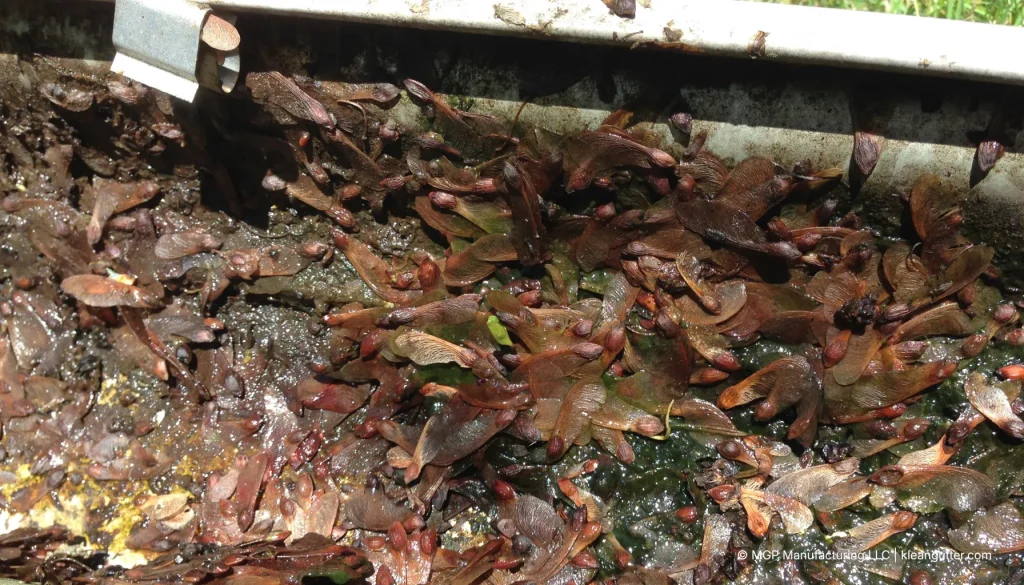
Fall gets the attention because leaves are easy to see. But count the actual pieces hitting your roof and spring usually wins. One mature maple can drop hundreds of thousands of winged seeds in a big year, and every bud that opened shed small husks on the way out. Those bits are small and dense, they don’t drift, they drop and settle. On a pitched guard, the next rain carries them toward the edge. On a flat one, they land, pack down, and start a base layer before spring is even half over, and that base layer is what the rest of the year builds on. The fine debris side of this is also where SelfClean Mesh™ keeps the surface clear (see /aegis-5x/selfclean-mesh/) at the mesh level.
Summer dries it in place
Summer adds dry debris, twigs, leaf fragments, sun-baked needles, all light enough for normal wind to move off a pitched surface. On a flat guard, they collect in the dead-wind zone at the gutter line, dry out, and stay. That’s also where the black-streak problem starts: as that debris breaks down on the surface, it releases stains and particles that rain washes down your fascia. Look at the fascia under your gutters, if you see dark vertical streaks, that’s debris that sat long enough to rot in place. The streak is the proof the guard kept debris instead of moving it.
Fall is the easy one, except for needles
A dry oak leaf is big and light, the same breeze that can’t budge packed spring debris will tumble it off a pitched guard in an afternoon. That’s the photo the marketing shows you. The real fall problem is pine and fir needles, narrow, dense, and shaped to weave together into a mat. Once that mat sets on a flat surface, it shrugs off wind, holds moisture, and builds year over year. On a pitched surface, flowing water carries needles sideways before they can lock together. And when wet debris stays packed against the fascia and soffit, those boards stay damp between rains, which is how roof-edge rot starts earlier than it should. That damp, slow-drying zone is also where the install method matters most: ShingleSafe™ protects the roof edge during install (see /aegis-5x/shinglesafe/).
Winter makes it structural
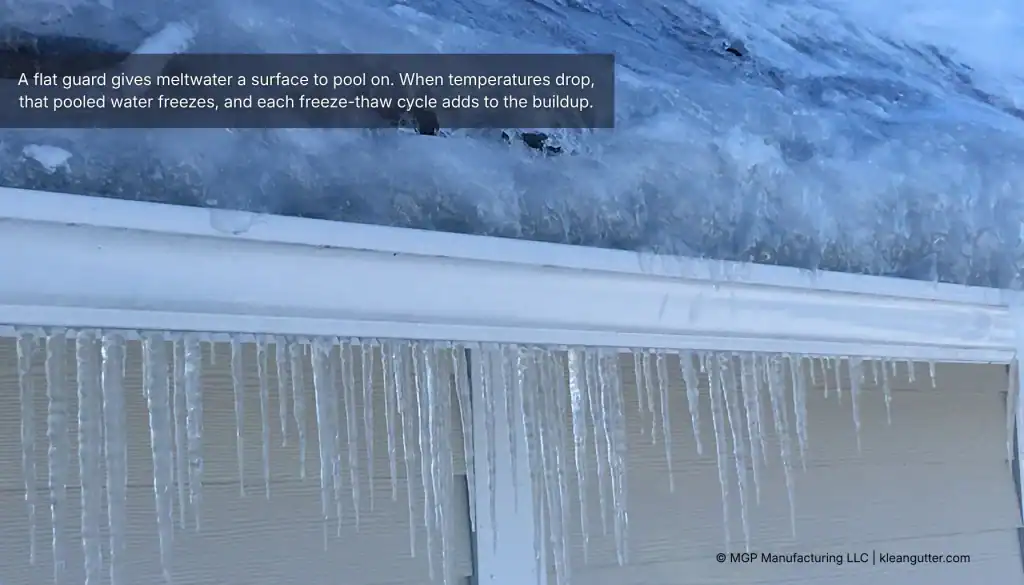
Winter is where a flat guard stops being a nuisance and starts being a real problem. Meltwater and wet debris sit on the flat surface, refreeze, and build up and back toward the shingles, a winter shelf right where the roof needs water to keep moving. Ice dams have more than one cause, but anything that gives water and ice a place to stop at the edge makes it worse. Pitch reduces that by giving meltwater a direction instead of a flat place to pool. And debris that sits damp long enough invites moss and algae, the living side of the problem that CopperCare™ handles with copper woven into the mesh
Four seasons, one story: a flat guard doesn’t fail in a single bad storm. It fails a little in every month of the year, while a pitched guard keeps the roof’s own work going straight through.
Four seasons, one shelf. If debris is parked on your guard after ordinary weather, or you see streaks on the fascia, that’s the shelf at work. Have someone read your roofline before the next storm or freeze and tell you what your edge is actually doing.
10M+ Linear Feet Installed | 0.009% Warranty Claim Rate | ASTM B117-16 Passed 1,000-Hour Corrosion Test | 5 Shingle Manufacturer Approvals | 3-Year Independent Real-World Field Test | 17 Utility Patents, All Insured by IPISC
Does Pitch Help With Heavy Rain, Steep Roofs, and Ice?
Pitch is the first question at the roof’s edge, but it isn’t the last. If you have a steep roof, valleys that funnel water, or hard winters, it helps to know what pitch handles and where it hands off. Pitch keeps water and debris moving. How much water actually gets into the gutter under a downpour is a different job, handled by HydroVortex™, the AEGIS 5X guardian for intake (see /aegis-5x/hydrovortex/). The two work together.
Steep roofs expose weak guards faster
On a steep roof, water and debris move with more speed and force. A guard that makes any shelf, even a small one, has less time to deal with what’s coming before it piles up or shoots past. A flat guard on a steep roof isn’t just a debris problem, it’s a water problem, high-speed runoff hits the flat face and has nowhere to go but over the edge. A guard that looks fine on a low-slope roof can fail in plain sight on a 10/12 or 12/12, because the faster water tests it harder.
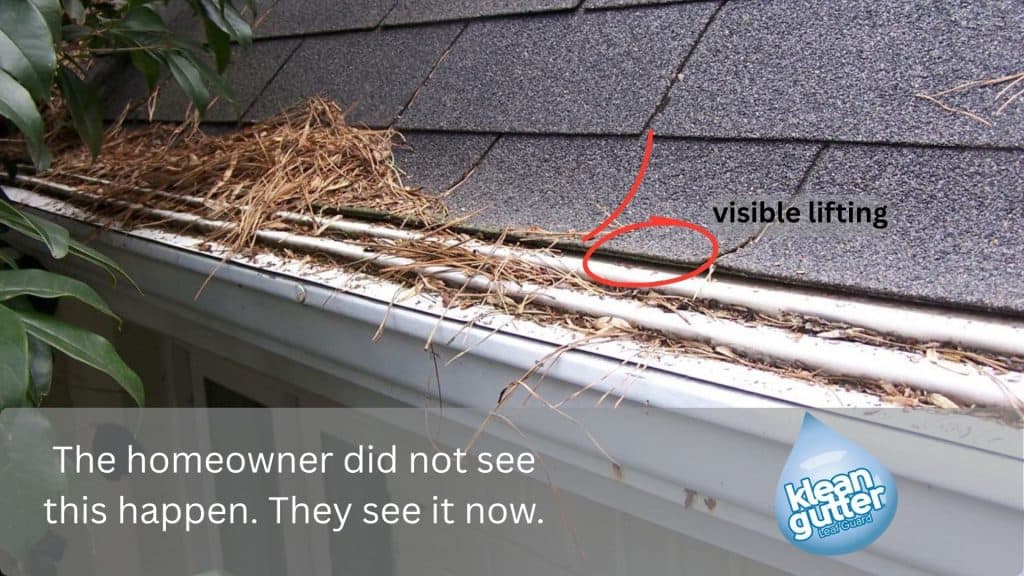
Why water jumps a restricted surface
When water comes down a roof with momentum and meets something that blocks its forward path, a raised lip, a flat face, a pinched intake, it doesn’t wait. It takes the easy way out, usually over the front of the guard and past the gutter. That’s the “overshooting” homeowners describe. Pitch keeps the water moving in the right direction, but intake capacity decides whether it actually gets in. A well-pitched guard with too little open intake will still overflow. Pitch and intake have to work as a pair.
Why ice is worse when water has a flat place to sit
A flat guard gives meltwater a surface to pool on before it drains. Temperatures drop, that pool freezes, the ice blocks the next round of melt, and each freeze-thaw adds to it. A pitched surface gives meltwater fewer places to stop on the way to the gutter. That doesn’t make pitch an ice-dam cure, valleys, complex roofs, and deep cold create ice no matter what. The point is narrower and true: a flat guard adds a risk a pitched one takes away.
Here’s the whole section in one line: pitch keeps the water moving, and intake lets it in. A guard that nails one and skips the other still loses the storm that matters most.
How to Tell If a Guard Isn’t Pitched Enough
You don’t need to measure an angle. Here’s the simple test. Look at your open gutter, the flat-bottomed trough on your roof right now. That flat bottom is exactly why gutters clog, debris settles and stays. Now ask: if a guard just moves that flat bottom from inside the trough to the top of the guard, what did it actually fix? A flat guard didn’t get rid of the shelf. It relocated it.
Does the guard’s surface follow your roof’s slope, or flatten over the gutter? This is the one you can answer from the driveway. A guard that continues the roofline looks like part of the roof. A guard that caps the gutter at a flatter angle is a shelf, whatever it’s made of.
After a good wind, is debris still sitting on the guard? Wind strong enough to flap a flag should move loose debris off a pitched surface. If it rides out that weather and stays put, the guard is sheltering it, and the angle isn’t enough for that roof.
In a hard rain, does water go in, or skip over the front? Pitch keeps the water moving; intake is what gets it in. Water shooting past the gutter is the sign that movement, intake, or both are wrong for your roof.
If wind should reach it and debris still sits, it’s not pitched enough
Wind at the roof’s edge isn’t constant or strong, but ordinary weather gives it a fair chance to move loose debris off a properly pitched surface. The rule of thumb: wind strong enough to flap a flag should move loose debris off a pitched guard. When debris rides out that kind of weather and stays put, the guard is giving it a sheltered place to rest, and the angle isn’t enough for that roof.
The old “installation angle” was a ceiling, not a standard
The industry has long quoted fixed installation-angle ranges. Those numbers described what a guard’s design could mechanically do, not what your roof actually needed. A guard that couldn’t follow a steep roof needed a spec that didn’t ask it to, and over time that ceiling got called a standard. A guard that can follow whatever pitch your roof presents has no use for a degree bracket, it just works with the roof.
Three kinds of “flat,” and how each fails
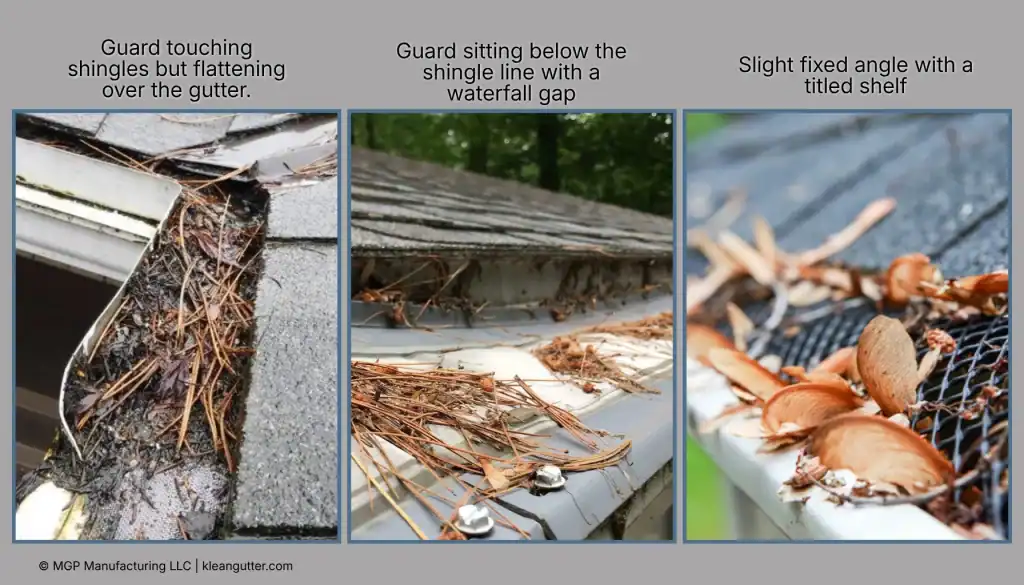
Not all flat is the same, and they fail in different ways:
Touching the shingles. Tucked under the shingle edge so it looks integrated, but if the surface flattens over the gutter instead of continuing the slope, it’s still a shelf, and the overhang can hide the debris from the ground. It also shrinks the open area over the trough, so the guard has less room to take water in. Looks right, performs as a ledge with a pinched intake.
Sitting below the shingles. The surface drops below the shingle line, leaving a gap. Water running off the shingle hits that gap, drops fast, and skips past the gutter, the waterfall effect, and the gap also becomes a hidden pocket for debris and moisture. Two failures from one gap.
A slight fixed angle. Some tilt, but not enough for that roof. Debris still settles, wind still skims over, and the pitch number sounds fine while the result looks flat. The shelf is tilted, not gone.
What you’ll see when a guard isn’t pitched enough
- Debris sitting on the surface after ordinary, breezy weather
- Water skipping over the guard in rain instead of going in clean
- Wet pockets or dark streaks along the surface between rains
- Ice forming on top and building up or sideways
- Slow drainage you can hear pooling before it reaches the downspout
Get a roofline check before the next storm or freeze. A Klean Gutter advisor will look at your shingle length, roof pitch, valleys, and gutter placement and tell you what your specific roof needs, not a standard angle, the right setup for your roofline.
10M+ Linear Feet Installed | 0.009% Warranty Claim Rate | ASTM B117-16 Passed 1,000-Hour Corrosion Test | 5 Shingle Manufacturer Approvals | 3-Year Independent Real-World Field Test | 17 Utility Patents, All Insured by IPISC
Why Klean Gutter Builds PitchPerfect Into AEGIS 5X
Go back to where this started, you walked outside after ordinary weather and saw debris parked on top of your guard. Nothing in the trough, but the debris sitting there, packing down, starting to look like it lived there. That moment is the whole argument. The guard was designed around the trough. PitchPerfect is designed around the roof’s edge, the spot where that debris should never have stopped.
Pitch isn’t cosmetic. It’s the first question every guard has to answer: does it keep debris, water, wind, and winter melt moving, or does it make a shelf? PitchPerfect is the roofline-alignment standard built into AEGIS 5X, the guard closely matches the pitch of your roof, not a fixed angle that works on an average one, so it inherits the shedding your roof already does. That’s a patent-backed mechanical standard, not an installer’s preference.
But pitch is only the first of five guardians, and the reason Klean Gutter holds up over time is that the other four cover what comes next:
SelfClean Mesh keeps the fine stuff moving, the pollen, grit, and small debris that passes the pitch test but still needs to be carried off the surface rather than driven into the mesh.
HydroVortex handles intake, the open geometry that lets heavy rain pour into the gutter instead of overshooting the edge. Pitch keeps water moving; HydroVortex gets it in.
CopperCare is Klean Gutter’s standout, copper woven right into the micromesh, where it holds back the moss, algae, and biological growth that take hold wherever a surface stays damp. It’s the part most guards have no answer for at all, and it’s a big reason Klean Gutter keeps performing in shady, wet spots that defeat ordinary mesh.
ShingleSafe protects the roof’s edge itself, controlling how the guard meets the shingle so the install doesn’t create a new weak point where the guard touches the roof.
Five guardians, one job each. Pitch solves the shelf. The other four solve what the shelf would have caused. That’s the smart-engineering part, and it’s the reason Klean Gutter can stand behind reliable, long-term performance at a price that respects your wallet, backed by a 25-year transferable warranty.
The One Question to Ask Before You Buy
Before you choose any gutter guard, ask the company one thing: does your guard’s surface follow my roof’s pitch, or does it flatten over the gutter?
If it flattens, you have your answer, you’re buying a shelf, and everything that lands on it has somewhere to stop. If it follows the roof, the forces already working on your roof keep working at the edge, and debris has nowhere comfortable to settle.
That’s what PitchPerfect does. The roof keeps moving debris. The guard stays out of the way. The only question that matters is which one your guard was built to be.

See the right setup for your specific roof. Every roofline is different, your pitch, your valleys, your shingle condition, and where the gutters sit all change what a guard needs. A Klean Gutter advisor will look at all of it and show you the right configuration for your home, before you buy, not after.
10M+ Linear Feet Installed | 0.00001% Warranty Claim Rate | ASTM B117-16 Passed 1,000-Hour Corrosion Test | 5 Shingle Manufacturer Approvals | 3-Year Independent Real-World Field Test | 17 Utility Patents, All Insured by IPISC
Frequently Asked Questions
Pitch and Angle
Does a gutter guard need to be pitched like the roof?
Yes. A gutter guard needs to match your roofline so the forces already moving debris and water down the roof keep working at the edge. Wind is one of the biggest clearing forces up there, and it can only move debris it can actually reach, so a flat guard leaves debris, water, and wind nothing to work with but the gutter opening. That turns the guard into a shelf instead of a continuation of your roof. PitchPerfect is the roofline-alignment guardian inside Klean Gutter’s AEGIS 5X standard, built to keep those forces working where they belong.
What angle should a gutter guard be installed at?
A gutter guard should be installed at your roof’s actual angle, the real pitch of your specific roof. Some older systems quoted a fixed degree range, but that described their mechanical limits, not what a roofline needs. On a low-slope roof the guard should follow that slope; on a steep roof, that pitch. The real test isn’t the number on a level, it’s whether debris stays put on the surface after ordinary weather, and if it does, the pitch isn’t enough no matter what the spec says. PitchPerfect is set to your roof’s actual pitch rather than a fixed bracket.
Should a gutter guard be flat or sloped?
A gutter guard should be sloped, and not just barely. A flat guard makes a shelf where debris, water, and ice stop and pile up, while a sloped guard continues your roof’s natural shedding and gives wind, gravity, and runoff a surface to work across. The question isn’t whether a little pitch beats none, it’s whether the pitch is enough for your roof, because a slight fixed angle that doesn’t closely match the roofline can still build a shelf. PitchPerfect is built to remove the shelf, not just shrink it.
Can a guard be pitched on a low-slope roof?
Yes. A gutter guard can be pitched on a low-slope roof, even though there’s less built-in slope for it to follow. The answer isn’t to give up on pitch, it’s to add as much slope as the install allows while keeping intake and drainage working for that geometry. A low-slope roof deserves a specific look from a trained advisor. PitchPerfect follows the same rule on every roof: follow what’s there, and where the roof gives you less, add more.
Flat Guards and the Shelf
What happens if a gutter guard is installed flat?
A gutter guard installed flat makes a shelf at your roof’s edge. Debris lands and stays, leaves, needles, seed pods, grit, and water pools instead of heading for the opening; in winter, meltwater sits and refreezes. Over time that buildup can block water from reaching the intake at all, so your gutters overflow even though the guard looks fine. It keeps the big debris out of the trough while collecting everything else on top of itself. PitchPerfect removes that shelf by following your roofline, so debris and water have somewhere to go instead of somewhere to sit.
Why does debris collect on top of my guards even when nothing’s getting in the gutter?
Debris collects on top of a flat guard because the surface gives it a place to stop and the wind can’t reach it to move it again. On a flat guard, wind skims over the debris instead of getting across it, and gravity has no sideways pull, so the guard becomes a shelf and a shelf does what shelves do. The fix isn’t cleaning more often, it’s a guard that doesn’t give debris a place to stop in the first place. PitchPerfect keeps the surface angled so wind and water have something to work across.
Do flat guards make a shelf for pine needles?
Yes. Flat guards make a shelf for pine needles, and needles are some of the most stubborn shelf-builders because of how they interlock. A flat surface gives them the geometry to weave into a mat, and once that mat sets it holds moisture, shrugs off wind, and gets harder to remove without a hand up the ladder. On a pitched surface, needles have less chance to lock together before water or wind moves them. PitchPerfect gives flowing water the angle it needs to carry needles sideways before they can layer.
Winter and Ice
Can gutter guards cause ice dams?
Gutter guards can add to ice-dam conditions when they’re laid flat. A flat guard makes a shelf where meltwater, wet debris, and ice sit at your roof’s edge, and when that refreezes it can block more melt from draining and push water back toward the shingles. Ice dams have several causes, attic heat, roof temperature, snow load, freeze-thaw, but a flat guard adds one more place for water to stop. PitchPerfect doesn’t prevent ice dams, but it removes the shelf condition that makes an existing risk worse.
Why does ice form on top of my guards after a thaw?
Ice forms on top of a flat guard because meltwater reaches the surface and finds a place to stop before it drains. Water pools at the face and in low spots, then freezes when the temperature drops, and the frozen mass blocks the next round of melt, with each freeze-thaw adding to it. A pitched surface gives meltwater fewer places to pool on the way to the gutter, so there are fewer spots where it can stall and refreeze. That’s the shelf condition PitchPerfect removes within AEGIS 5X.
Are flat guards worse in winter?
Yes. Flat guards are worse in winter, for two reasons. A flat surface pools meltwater instead of draining it, and pooled water is what freezes. On top of that, all the debris the guard collected through spring, summer, and fall is still sitting there in January, holding moisture and crowding the limited intake, so the shelf that was a nuisance in October becomes a real problem in deep winter. PitchPerfect helps on both fronts: fewer places for water to stop, and fewer shelf zones for debris to pile up all year.
Subtitle
Why are my guards overflowing in heavy rain when the gutter looks clear?
Gutter guards overflow in heavy rain with a clear gutter usually for one of two reasons: the surface is slowing water before it reaches the intake, or the intake area is too small for the volume your roof is delivering. A flat guard feeds the first problem by pooling and spreading water instead of moving it to the opening. Pitch keeps the water moving, but intake geometry decides whether it gets in fast enough. PitchPerfect handles the movement, and HydroVortex, the AEGIS 5X guardian for intake, handles getting it in.
Do gutter guards work on steep roofs?
Gutter guards can work on steep roofs, but a steep roof exposes a weak design faster. Water and debris move with more speed, so any shelf or restriction gets tested harder, and a guard that’s fine on a low-slope roof can overflow or collect debris on a 10/12 or 12/12. PitchPerfect follows the roofline at steep angles instead of forcing a fixed angle calibrated for flatter roofs, which is exactly where it earns its keep.

Aaron Kapfer — Author.
Aaron is the Success Team Leader at MGP Manufacturing LLC and has worked in gutter protection since 2000. Originally from Cape Girardeau, MO, he has spent more than two decades across the industry, training installers and helping companies read real roof-edge conditions and set realistic expectations with homeowners. His hands-on experience across guard types and roof conditions makes him one of the most practical voices in the field on how these products hold up over time.

Contributor — Karen Sager
Karen is the President of MGP Manufacturing LLC and a veteran of more than 20 years in gutter protection. She holds nine utility patents for gutter guard filters and components and works closely with the national dealer network on real-world installations. She is quoted on this page as a field source; the page’s author is Aaron Kapfer. When she writes or speaks about gutter guards, she draws on field experience, product development, and long-term performance data, not marketing claims.
