
Self-Cleaning Gutter Guards: How to Tell Real From Marketing

Quick Answers
You're shopping for a gutter guard for one simple reason: you want to stop climbing the ladder. Every brand promises that, and for fall leaves, most of them keep it.
The trouble shows up the second spring. Not because the gutter filled up, but because something is sitting on top of the guard that has nothing to do with leaves.
The real culprit is the small stuff that arrives after the leaves are gone: pine needles, maple seeds, shingle grit, and a thin, almost invisible film that turns the surface sticky over time. That is what most guards were never built to handle.
SelfClean Mesh™ is one of five guardians in Klean Gutter®'s AEGIS 5X® engineering standard, and it owns one job: keeping that small stuff from settling. The idea is simple enough to watch on a rainy day: moving water carries debris off the surface, still water lets it stay. Because the guard sits at your roof's pitch, every rain becomes a rinse.
Here's the one question that separates a real self-cleaning guard from a good slogan: ask what it does with the debris you can't see. If the answer is only about leaves, keep shopping.
Quick Answers
Do gutter guards really end gutter cleaning for good? Gutter guards can end cleaning for many homes, and come close for the rest. It comes down to two things: what lands on your roof, and what the guard is built to do with it. “Maintenance-free” is true for leaves and not much else; pine needles, seeds, grit, and roof film are a different problem, and a guard has to be engineered for them, not just labeled for them. SelfClean Mesh™ is the part built to handle that fine load on the surface.
Do you still have to clean gutters if you have guards? Most guards still leave you cleaning, just on top instead of inside. They keep junk out of the trough but let it pile on the face, so you’re still on the ladder. SelfClean Mesh is built so debris can’t settle on the surface in the first place, which is the part that actually keeps you down.
Is “maintenance-free” a real thing or a sales line? “Maintenance-free” is a little of both. Every brand has used the phrase, and in tough yards every guard needs some attention. The fair question isn’t “will it ever need a look,” it’s “was it designed to make that rare?” SelfClean Mesh has three working parts aimed at exactly that.
Want the short version for your roof? A Klean Gutter advisor will look at your trees, your debris, and your roofline and give you a real maintenance estimate before you buy, not after.
10M+ Linear Feet Installed | 0.009% Warranty Claim Rate | ASTM B117-16 Passed 1,000-Hour Corrosion Test | 5 Shingle Manufacturer Approvals | 3-Year Independent Real-World Field Test | 17 Utility Patents, All Insured by IPISC

Why "Maintenance-Free" Guards Still Send You Up the Ladder
It’s the second spring after the install. You look up from the driveway and there it is again: a soft mat of needles and seed pods resting right on top of the guard you were told you’d never have to touch. The trough underneath is clear. The top isn’t. And the ladder is coming back out.
Here’s the truth, and it’s simpler than the marketing makes it sound. Every gutter guard ever sold told the truth about leaves. Leaves are big, light, and dry. They blow off or pile up where you can see them, and almost any guard that covers the opening handles them well enough for a nice photo.
The problem is everything that isn’t a leaf. Pine needles don’t blow off; they thread into the surface and stay. Maple seeds have little wings that lock together, so once they layer, they shrug off the same breeze that clears a leaf. Spring buds drop wet, pack down in the rain, and leave a residue you won’t notice for months.
Then there’s a third kind of mess that doesn’t even look like debris. Roof oils from aging shingles, road dust, and fine grit don’t land as pieces you can brush away. They settle as a film. They coat the surface. And quietly, they change what the surface is.
That last one is where most guards fail without anyone noticing. A smooth-curve guard works because water hugs the curve; coat that curve in oily grit and the water stops hugging and starts overshooting. The guard is still up there. The trick it relied on is gone. Flat screens turn that same film into glue, so everything that lands next sticks harder than it did the year before.
So the guard that breezed through year one starts collecting faster by year three, because the surface that let it shed got slowly ruined by something nobody was watching.
That’s the call we get all the time at Klean Gutter, and it’s never “my gutters overflowed.” It’s “I bought guards and I’m still up here cleaning them.” The product kept its small promise, leaves stayed out of the trough, and broke the big one the homeowner actually heard.
The question “maintenance-free” was always supposed to answer isn’t what happens to leaves. It’s what happens to everything that lands after them. SelfClean Mesh is built to answer that across all three kinds of debris, not just the easy one.
What SelfClean Mesh Is, in Plain Terms
Before the engineering, here’s what it means for you: SelfClean Mesh is the part of Klean Gutter that keeps the surface clear, so the small stuff that traps other guards never gets a chance to settle.
SelfClean Mesh™ is one of the five guardians inside the AEGIS 5X® engineering standard that every Klean Gutter is built on. It answers one question: once debris of any kind lands on the guard, what happens to it? The whole thing comes down to three simple moves. First, the surface is steep enough that debris has somewhere to go. Second, water is guided onto the mesh while it’s still moving, and it carries debris along with it. Third, at each opening in the micromesh, the water makes a sharp turn that scrubs the mesh clean, and it scrubs harder the heavier it rains.
A fourth thing rides along with all three: that same moving water keeps the invisible film of roof oils and grit from ever setting up. They all depend on one starting condition, so let’s start there.
First, the surface has to be steep enough
Picture a wet leaf on your windshield. Park flat and it just sits there. Tilt the glass and it slides right off. A pine needle on a roof behaves the exact same way: below a certain steepness it rests, above it, it travels.
Engineers call that tipping point the angle of repose, the slope where stuff stops sitting still and starts to move. The plain-English rule that falls out of it is blunt: if a surface is too flat for debris to move, it’s too flat to self-clean.
A flat guard fails this no matter how fine the holes are or what it’s made of. Lay any premium mesh flat and gravity pushes straight down into the debris instead of across it, so nothing slides. The angle has to come first.
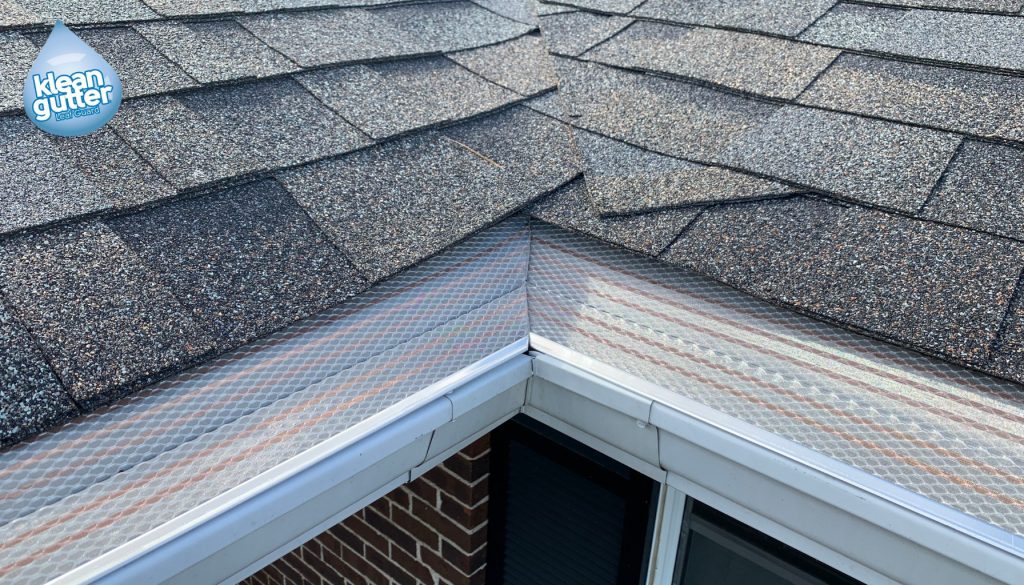
SelfClean Mesh clears that bar with simple geometry, because Klean Gutter is installed at the pitch of your roof, a job handled by PitchPerfect™, the guardian that sets the angle SelfClean Mesh needs. Your roof already sheds water down its slope. SelfClean Mesh just borrows that same slope for debris.
PitchPerfect™ sets the angle SelfClean Mesh needs. →
Move one: the water sweeps the surface
Rain hitting a flat mesh drops straight through. There’s no sideways push, so small spring debris settles, stacks, and covers the holes. Now tilt that same mesh to the roof’s pitch. The water slides down the surface first, and that slide gives it sideways speed before it ever passes through.
That sideways speed is the whole trick. The moving water acts like a stream in a creek, carrying loose debris toward the edge before it can settle. A maple seed that lands isn’t waiting around for a lucky gust; it gets caught in moving water and pushed toward the gutter’s edge.
This isn’t gravity alone, and it isn’t wind. The water does the carrying. A flat guard can’t copy it, because a flat guard lets go of the water before it reaches the mesh. On a flat guard, debris settles. On SelfClean Mesh, it rides off. That’s the line worth remembering, and you can watch it on any rainy day: moving water carries the small stuff, still water leaves it behind.
Move two: heavy rain cleans instead of clogs
Here’s the part that surprises people. On a flat guard, a downpour is the enemy: more water just presses debris deeper into the holes and packs them tight. On SelfClean Mesh, the same downpour does the opposite.
When water racing across the pitched guard reaches an opening, it has to make a sharp turn to pass through the filter, a hand-off that the HydroVortex™ intake geometry sets up. That sharp turn kicks off a small, intense scrubbing action right at each opening, and it gets stronger the faster the water moves. More rain means more scrubbing, not more clogging.
You can’t watch this one happen; the openings are far too fine. You see the result over the years instead. You never catch the mesh cleaning itself, but season after season you notice the same thing: it just never needs clearing.
On the older installs, folks expect me to find a clogged mesh up there. I keep telling them, that's the whole point, there's nothing to find. The storms that wreck a cheap guard are the same storms keeping this one clean.
Aaron Kapfer, Field Authority
How the scrub actually works.
Most of the fine particles riding on top of the filter, pollen, grit, silt, get swept off by the moving water before they can settle anywhere. That’s move one doing its job. But some particles do work their way into the upward-facing openings between storms. Here’s what happens to those the next time it rains.
Think about a sharp bend in a river. The water turns the corner, but heavier things in it, sticks and litter, get thrown to the outside of the bend, because they carry more momentum and can’t change direction as fast as the water. The same thing happens inside each tiny opening: water enters and turns down through the mesh, and the heavier particles can’t follow the turn, so they get knocked loose instead of lodging in. Scientists call that inertial impaction.
At the same moment, that sharp turn makes the water spin off into a tight little eddy right at the edge of each opening, and the eddy scrubs the mesh exactly where buildup would start. The faster the water, the harder it scrubs. The same storm that packs a flat mesh tight is actively clearing this one.
Move three: the film never gets to set
There’s a kind of mess that doesn’t act like debris at all: the roof oils, dust, and fine grit that settle as a coating instead of landing as pieces.
Think of candle wax dripping onto a counter. While it’s warm it wipes right off; let it sit and harden and it grabs everything you set on it. Roof oils do the same on a guard surface, they cure into a sticky base, dust settles into it, and within a season or two a clean mesh has quietly turned into a primed one that holds debris tighter than when it was new.
SelfClean Mesh handles that film with the same tool it uses for everything else: moving water at pitch. Every rain is also a rinse, so the film never sits still long enough to cure. The same rain that would lay it down is the rain that washes it away.
That’s why the gap between SelfClean Mesh and an ordinary guard widens over the years instead of holding steady. The cheap guard’s surface slowly turns to glue. This one stays the surface it started as. The living side of that problem, moss and algae, belongs to CopperCare™, the copper woven right into Klean Gutter’s mesh, and the two work as a pair.
A quick word on why Klean Gutter handles this so well: the mesh is 100% metal, with no foam or vinyl to soak up grime, and we’ve measured the surface against the field. Of every guard that runs a thin mesh over a support frame, Klean Gutter’s gives water the most open filtering area to work across. More surface, more rinse.

How SelfClean Mesh Fits the Rest of AEGIS 5X
Most gutter guards fail the same quiet way: they fix one problem and lose to the next. A guard can shed leaves beautifully and still get glued shut by roof film. It can sit at the perfect angle and still grow over in a shady, damp corner. Fix one thing, the next one gets you.
That’s the trap SelfClean Mesh is built to dodge, and the reason it doesn’t work alone. AEGIS 5X is the five-part engineering standard every Klean Gutter is built to, and each of its five guardians owns one failure point at the roof’s edge, so no single weak spot can drag the whole surface down with it. Three of them carry the load right here, and the hand-off is simple.
PitchPerfect sets the guard at your roof’s pitch instead of flat over the gutter. That’s the starting condition. Without enough angle, nothing sheds, so everything SelfClean Mesh does depends on PitchPerfect being right first.
SelfClean Mesh then puts that angle to work three ways: it sweeps debris off before it settles, it lets every rain scrub the openings clear, and it rinses the oily film before it can set. The pitch makes the water move; SelfClean Mesh spends that motion.
CopperCare guards what’s left. Copper woven into the mesh holds back the moss and algae that are the living side of surface trouble. Even a surface kept free of oily film can grow over in a shady, damp spot, and CopperCare stops it.
Put them together and you get a guard built so performance doesn’t fade just because the surface ages. That’s the smart-engineering part, and it’s the reason Klean Gutter can promise reliable performance at a price that respects your wallet. With the system in view, here’s the debris it’s up against.
Not sure how the system fits your roof? A Klean Gutter advisor will read your pitch, your trees, and your debris, and tell you plainly what staying off the ladder looks like for your home.
10M+ Linear Feet Installed | 0.009% Warranty Claim Rate | ASTM B117-16 Passed 1,000-Hour Corrosion Test | 5 Shingle Manufacturer Approvals | 3-Year Independent Real-World Field Test | 17 Utility Patents, All Insured by IPISC
Pine Needles, Maple Seeds, and the Mess That Changes the Rest
The marketing photo for most guards is shot in late fall: clean surface, clear trough, job done. That’s a fair picture. It’s also one slice of the year. The debris that actually generates the phone calls comes in three kinds, and each is its own problem.
Pine needles don’t arrive all at once like leaves; they drift down a few at a time all season and build a layer over weeks. On a flat guard, rain drives that layer into the mesh and the flat surface holds it there until someone climbs up. On SelfClean Mesh at pitch, the moving water carries needles toward the edge before a layer can form. Fir needles are the tougher cousin, shorter and denser, so a big fir over the roofline is worth flagging to your advisor, because tree cover is what sets a realistic cleaning estimate.
Maple seeds bring a different trick: wings. When they land, the wings catch and overlap, and one seed locks onto the next until the whole layer grips itself. Wind that clears a dry leaf can’t budge an interlocked seed mat. On a flat guard, seed season can mean a hand-cleaning. On a pitched guard with water moving across it, seed season comes and goes without a layer ever forming.
Then there’s spring, the most underrated season and the one most “maintenance-free” claims were never built for. Before the leaves even show, trees drop buds, catkins, pollen, and husks: small, plentiful, and sticky the second they get wet. They arrive in the rain that soaks them, and that same rain packs them into a thin, dense mat that’s harder to move than a leaf pile twice its size. So a guard that sailed through fall can flunk its very first spring. Fall debris is big, light, and dry. Spring debris is small, wet, and stubborn. Not the same problem.
Everybody tests their guard in October and calls it a win. Spring's the real exam. The call's always the same: the gutter's clear, but the top of the guard is matted over. That guard passed the easy test and flunked the hard one.
Aaron Kapfer, Field Authority
And the film we met earlier deserves its own line here, because of which guards it quietly kills. A smooth-curve guard leans on a clean surface to pull water in; once oily grit roughens that surface, water that used to wrap into the gutter runs over the front instead. Performance drops, and not from leaves or needles, but from the film that was invisible the whole time. SelfClean Mesh can name that problem because moving water rinses it off every time it rains, and CopperCare handles the living growth that would otherwise feed on it.

How Often Will You Actually Clean Your Gutters?
This is the real question under every “maintenance-free” search, so here’s a straight answer: it depends on your yard, your trees, and your roofline. Any company that gives one number for every house is selling a slogan. Underneath all of it is the same rule playing out in different yards, where the water keeps moving across the surface, debris doesn’t stay, and the ladder stays in the garage. The more your trees test that rule, the more you want a real number, not a promise.
Open sky or a few trees. For most homes here, SelfClean Mesh ends scheduled cleaning. Debris is light, the film load is low, and the three moves handle it with no help. Glance up now and then; don’t book a cleaning.
Mixed trees, moderate cover. Expect a sharp drop, from the two or three cleanings a year a standard guard needs down to the occasional look. After a heavy maple-seed or husk year, a light clearing may be worth it. The kind of maintenance changes: you’re checking to confirm, not climbing to clear.
Heavy, pine-dominant, or wet-coast cover. This is where the answer has to include “sometimes.” SelfClean Mesh clearly outperforms a standard guard here, and an annual look is still smart. Fir or pine straight over the roofline throws debris that challenges any guard; this one just handles it better. It won’t pretend to erase it in every yard.
A note on the right claim. “Virtually maintenance-free” is fair phrasing. What earns it is engineering that keeps debris from settling, not a promise that nothing will ever land. That’s the difference between a guard built for your specific yard and one built for the average one. The yard decides the schedule. The engineering decides how much of one you still have.
A Klean Gutter advisor will look at your tree cover, your debris type, and your roofline and give you a realistic number for your home, not a universal claim.
10M+ Linear Feet Installed | 0.009% Warranty Claim Rate | ASTM B117-16 Passed 1,000-Hour Corrosion Test | 5 Shingle Manufacturer Approvals | 3-Year Independent Real-World Field Test | 17 Utility Patents, All Insured by IPISC

The Real Cost of "Just Brush It Off Once a Year"
When a guard company says “just brush it off once a year,” hear what that sentence actually asks of you. It asks you to get on a ladder. For a two-story home, that’s a 24-foot extension ladder, with a tool in one hand.
Ladder falls aren’t a rare thing. The CDC’s National Institute for Occupational Safety and Health tracks them, and notes plainly that the danger isn’t limited to job sites; gutter cleaning is one of the most common reasons a homeowner gets on a ladder at all. In 2020 there were 161 workplace ladder deaths and 22,710 workplace ladder injuries, and those figures don’t even count the falls that happen at home.
For an older homeowner, or anyone with balance or knee trouble, “once a year” isn’t a Saturday chore; it’s a service call, a ladder rental, or a real risk, and every one of those is a cost the guard was supposed to remove. The true price of a guard that doesn’t clean itself isn’t the hassle. It’s the ladder.
By engineering the surface so debris can’t settle across all three kinds, SelfClean Mesh takes away the reason to make that climb. In most yards, it takes it away entirely. The goal was never a safer ladder. It was no reason to get on one.
The One Question to Ask Before You Buy
Before you choose any gutter guard, ask the company one thing: what does your guard do with the debris I can’t see? If the answer is only about leaves, you have your answer, that guard was built for the easy season. If the answer is about keeping the whole surface moving, fine debris, grit, and the film included, you’re looking at a guard that was actually engineered to keep you off the ladder.
That’s what SelfClean Mesh does. Moving water carries the small stuff. Still water leaves it behind. The only question that matters is which one your guard was built to be.
Most homeowners are told their new guard will never need cleaning, then learn the hard way that the claim was written for a different yard than theirs. A Klean Gutter advisor will look at your tree cover, your debris, and your roofline and give you a straight, realistic picture, before you buy, not after.
10M+ Linear Feet Installed | 0.009% Warranty Claim Rate | ASTM B117-16 Passed 1,000-Hour Corrosion Test | 5 Shingle Manufacturer Approvals | 3-Year Independent Real-World Field Test | 17 Utility Patents, All Insured by IPISC
Frequently Asked Questions
Maintenance and cleaning
Do gutter guards really end maintenance forever?
Gutter guards don’t end maintenance forever in every yard, and not with every guard, but the right engineering gets very close for most homes. It comes down to two things: what debris lands on your roof, and what the guard is built to do with it. Most “maintenance-free” claims only describe leaves, while pine needles, seeds, grit, and the roof film that coats the mesh are different problems that most guards were never designed for. A guard built for all three, the right pitch, the right surface, copper for biological growth, can genuinely end cleaning in most yards. That’s what SelfClean Mesh™, the surface guardian in Klean Gutter’s AEGIS 5X standard, is built to do; a bare claim with no engineering behind it can’t.
Do you still have to clean gutters if you have guards?
Most gutter guards still require cleaning, because they were built to keep debris out of the trough, not off the face. When needles or wet spring debris mat on top, you’re still on a ladder, just cleaning the guard instead of the gutter. SelfClean Mesh is built so debris can’t settle on the surface: the pitch puts it in moving water, the openings stay clear with every rain, and continuous flow keeps the film from forming. In open and moderate yards, that ends scheduled cleaning; in heavy yards it drops it to the occasional look. Any advisor who gives the same answer to every house is selling a claim, not an honest estimate.
Is "maintenance-free" real, or just a sales line?
“Maintenance-free” is both real and a sales line, depending on the guard. Every brand has used the phrase, and in tough conditions every guard needs some attention. The fair question is whether the guard was designed to make that rare. SelfClean Mesh answers at the surface with three moves, it sweeps debris off, it lets rain scrub the openings, and it rinses the film away, not because nothing ever lands, but because it was built so nothing can stay.
How it works
How does a self-cleaning gutter guard actually clean itself?
A self-cleaning gutter guard needs one thing to be true, then it does three jobs. The one thing: the guard has to sit at a pitch steep enough that debris slides instead of resting. Then it sweeps (moving water carries debris off before it settles), it clears its own openings (every rain rinses the mesh, harder rain rinses harder), and it rinses (that same flow keeps an oily film from turning the surface to glue). SelfClean Mesh, the AEGIS 5X guardian for the surface, is built to do all three; a flat guard can do none of them, because flat installation gives up the moving water that makes all three work.
Why does pitch matter so much?
Pitch matters because nothing moves across a flat surface. At your roof’s angle, debris slides toward the edge and water keeps moving across the guard instead of dropping straight through. Lay that same mesh flat and gravity pulls straight down into the debris, water arrives as a falling drop with no sideways push, and everything just sits. The quality of the mesh doesn’t change that. The angle has to come first, which is why AEGIS 5X makes pitch its own guardian, PitchPerfect™, the starting condition every other guardian depends on.
Does heavy rain clog these guards or clean them?
Heavy rain clogs a flat guard but cleans a pitched one. On a flat guard, a downpour packs debris into the openings, more water, more pressure, a tighter clog. On a guard at roof pitch, the same storm does the opposite: the moving water clears the openings, and it clears them harder the heavier it comes down. Same weather, opposite result, and it all comes down to whether the water is moving across the surface or just pressing down on it. That reversal is SelfClean Mesh doing its job within AEGIS 5X.
Fine debris
Do these guards keep out pine needles?
Most guards keep needles out of the trough, and a fine micromesh does too. The real difference is what happens on the surface. A flat guard builds a needle mat over the season that won’t clear without a hand. SelfClean Mesh at pitch carries needles off in the moving water before they layer. Fir needles are the harder case, shorter and denser and shedding all season, so homeowners with big firs over the roofline should walk through that specific condition with an advisor for a straight expectation.
What about maple seeds and shingle grit?
Maple seeds are winged, so they interlock when they layer, and an interlocked mat grips itself against wind that would scatter a dry leaf. On a flat guard, the spring drop can mean a hand-cleaning. On a pitched guard, the seeds arrive in the same rain that creates surface flow, and that flow carries them off before they lock together. Shingle grit is the fine mineral the roof sheds as it ages; it coats the mesh and feeds the film, and moving water carries it off as part of the same rinse, while CopperCare™ holds back the growth the film would otherwise feed.
Why does a guard that worked at first get worse over time?
A guard that worked at first gets worse over time because most guards depend on a clean surface to work, and the surface doesn’t stay clean. Roof oils, dust, and grit settle on everything below the roof edge, and over a season or two a fresh mesh becomes a primed one that holds debris and resists shedding. A guard that worked in year one can stop in year three, not from any one storm, but because the smooth surface its trick needed no longer exists. SelfClean Mesh doesn’t count on luck to stay clean; it keeps the surface clean by mechanism, rinsing it with every rain.

Karen Sager — Author.
Karen Sager is the President of MGP Manufacturing LLC and a veteran of more than 20 years in the gutter protection industry. She holds nine utility patents for gutter guard filters and components, and she's the inventor of both the CopperCare copper-in-the-mesh weave and the HydroVortex momentum-driven intake. She works closely with the national dealer network on real-world installs, and what she writes about gutter guards comes from engineering she designed and tested, not marketing claims.

Contributor — Aaron Kapfer, Field Authority.
Aaron is the Success Team Leader at MGP Manufacturing LLC and has worked in gutter protection since 2000. Originally from Cape Girardeau, MO, he has spent more than two decades across the industry, training installers and helping companies read real roof-edge conditions and set realistic maintenance expectations with homeowners. He contributes field perspective to this page; the page's author is Karen Sager.
